Historical figure · History of Russia · 19th century
Nikolay I Pavlovich
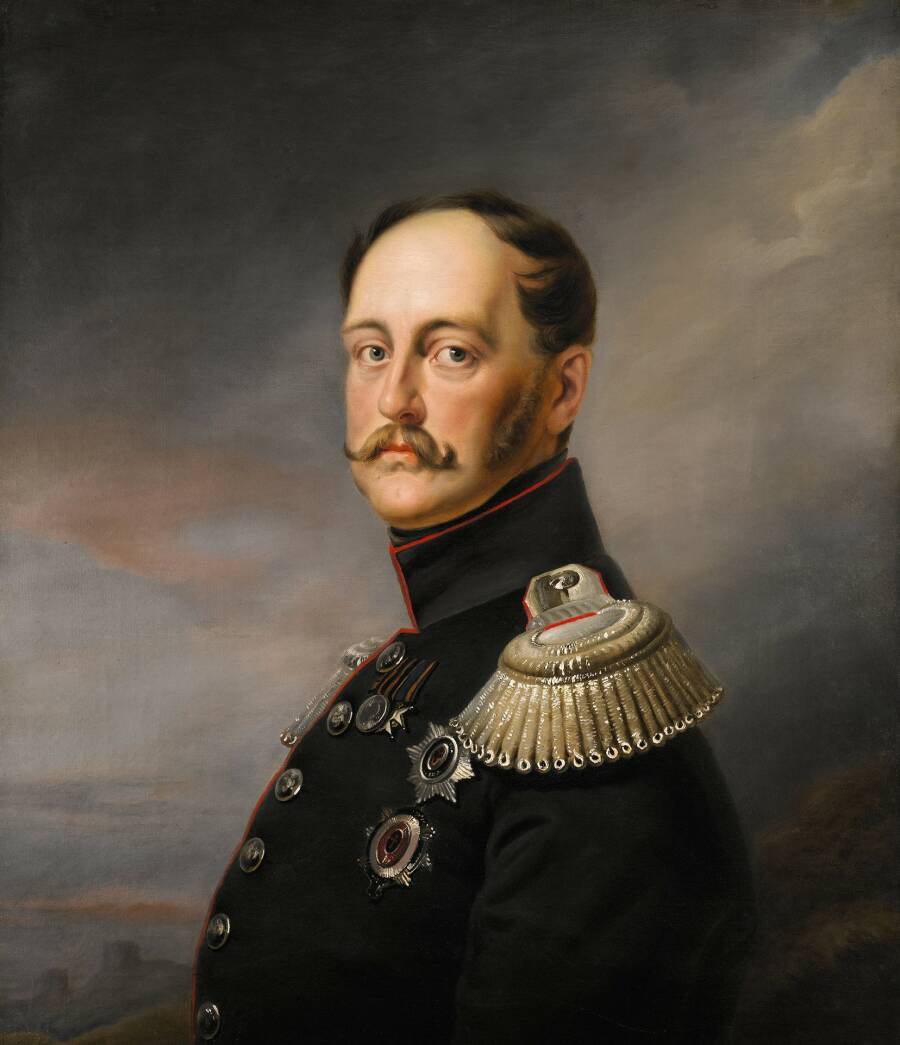
👶 Nicholas Pavlovich was born in 1796 and was the third son of Emperor Paul I, and since he was not raised in childhood as heir to the throne, the grand duke's upbringing was predominantly military in character, instilling in him from an early age a love of drill, discipline, and order. Unlike his elder brother Alexander, who received a liberal education under La Harpe's guidance, Nicholas was raised in a stricter and more conservative atmosphere, which later shaped his firm convictions about the necessity of strong autocratic power and unshakeable order as the foundation of the state's well-being.
⚔️ Nicholas I's accession to the throne in 1825 took place under dramatic circumstances: after the sudden death of the childless Alexander I, a period of interregnum arose, since the legitimate heir Constantine Pavlovich had earlier renounced his rights to the throne, a fact unknown to the wider public. Taking advantage of the resulting confusion, a group of noble officers, later known as the Decembrists, attempted on December 14, 1825, to raise an uprising on Senate Square to prevent Nicholas's accession and secure constitutional reforms, but the revolt was swiftly and decisively crushed by troops loyal to the emperor.
🏛️ Shaken by the December events, Nicholas I pursued a consistent policy throughout his thirty-year reign of strengthening autocracy and tightening control over society: the notorious Third Section of His Imperial Majesty's Own Chancellery was created to conduct political surveillance, censorship was tightened, and any expressions of free thought were ruthlessly suppressed. At the same time, the emperor sought to centralize and systematize state administration, entrusting Mikhail Speransky with the codification of Russian laws, which culminated in the publication of the complete Digest of Laws of the Russian Empire.
💔 Nicholas I's foreign policy, aimed at establishing Russia as the chief guardian of European conservative order, included the suppression of the Polish uprising of 1830–1831 and the Hungarian revolution of 1849, as well as the protracted and ultimately catastrophic Crimean War, which began in 1853. Military setbacks that exposed Russia's technological and organizational backwardness compared to the European powers dealt the emperor a devastating blow, undermining his health, and in 1855, without living to see the war's end, Nicholas I died in the midst of the siege of Sevastopol.
Key dates
- 1796 — birth of Nicholas Pavlovich
- November 1825 — death of Alexander I and beginning of the interregnum
- December 14, 1825 — Decembrist uprising on Senate Square and Nicholas I's accession to the throne
- 1826 — creation of the Third Section of His Imperial Majesty's Own Chancellery
- 1830-1831 — suppression of the Polish uprising
- 1830s — codification of laws under Speransky's direction
- 1833 — publication of the Digest of Laws of the Russian Empire
- 1849 — suppression of the Hungarian revolution
- 1853 — beginning of the Crimean War
- 1855 — death of Nicholas I during the siege of Sevastopol